Do You Actually Need a Car in Sydney?
9 min read

Most articles about hiring a car in a city are written by people who would like you to hire a car. This one starts with the opposite conclusion, because in Sydney it is the correct one for most visitors: for the city itself, a car is a liability rather than an advantage. It costs more, it is slower on the routes you will actually use, and it hands you a parking problem at every stop.
That is not the whole answer, though. Sydney is a city where the good day trips run in every direction and the public transport thins out fast once you leave the suburban rail network. The car earns its keep out there – and whether it earns enough to be worth hiring is a question with a real answer, not a marketing one.
What a day on public transport actually costs
This is the number that decides the argument, and it is smaller than most visitors expect.
| Opal cap | Amount |
|---|---|
| Daily cap, Monday to Thursday | A$19.30 |
| Daily cap, Friday, Saturday, Sunday and public holidays | A$9.65 |
| Weekly cap | A$50 |
Those are caps, not fares. Once you hit them, everything else that day – train, metro, bus, ferry, light rail – is free. A Saturday in which you take the ferry to Manly, a train to Bondi Junction, a bus to the beach and a train back to the city costs A$9.65 in total. You do not need an Opal card to get this; a contactless bank card or phone works the same way and earns the same caps.
Two things follow that matter more than any brochure.
First, the ferry is not a tourist add-on here. It is scheduled public transport under the same cap, which means the most scenic transport in the city is effectively free once you have travelled anywhere else that day. Anyone comparing a harbour sightseeing cruise against a ferry should know that.
Second, the weekly cap of A$50 means a seven-day visitor spending every day out in the city pays less for a week of unlimited transport than a single day of central parking plus tolls. Which brings us to the other side of the ledger.
What the car costs before it has taken you anywhere
Parking. City of Sydney on-street ticket parking is A$9 an hour in Area 1 and A$7 an hour in Area 2, and the charges apply at all times, including public holidays. There is no free evening, no free Sunday. Four hours at a meter near the harbour costs more than three days of capped public transport.
Tolls. Every toll road in Sydney is cashless – there are no booths and no coins. The Sydney Harbour Bridge and the Harbour Tunnel are tolled southbound only, that is, on the way into the city: A$4.55 in the weekday peaks (6:30 am to 9:30 am and 4 pm to 7 pm) and between A$2.85 and A$3.41 outside them. Cross the bridge northbound and you pay nothing.
The motorways are the expensive part. The Eastern Distributor is A$10.48 for a car, the Cross City Tunnel A$7.41, NorthConnex and the M2 A$10.64 each, the Lane Cove Tunnel A$4.30. The M7 is charged by the kilometre and capped at A$10.50. It is genuinely possible to spend A$25 in tolls on a single afternoon without noticing, because nothing ever asks you to pay.
And that is the trap. Since there is no barrier, a hire car simply accrues tolls that the rental company bills to your card afterwards, usually with an administration fee attached. That is covered properly in the article on excess, deposits and counter charges – it is the single most common unpleasant surprise on an Australian car hire bill.
The one place public transport is genuinely expensive
Honesty cuts both ways, and there is one glaring exception: the airport.
The train goes to both terminals and runs from 5 am to midnight, but the Domestic and International stations are privately operated and add a station access fee of A$18.61 per adult and A$16.64 per child or youth, on top of the ordinary fare. That fee sits outside the daily and weekly travel caps – it has its own separate weekly cap of A$37.75 for adults. There is no 60-minute transfer at airport stations either, so tapping off and on again within the hour costs you the fee twice.
For a family of four arriving at the International terminal, the access fee alone is around A$70 before anyone has bought a ticket. Against that, the flat taxi fare to the city centre – A$60 under a trial that began on 3 November 2025, for an uninterrupted trip – is not merely competitive. It is cheaper, quicker and involves no luggage on stairs.
If you are travelling as a couple, take the train. If you are three or more with bags, take a taxi. That is the whole calculation, and it is the only point in Sydney where the maths favours a road vehicle over the network.
Route 420 also serves both terminals, and the 350 runs from the Domestic terminal to Bondi Junction at least every ten minutes during the day, without a station access fee. It is slower. It is also a great deal cheaper.
Where the car finally starts to make sense
Everything so far argues against hiring. The argument turns at the city limits – but not everywhere, and not immediately.
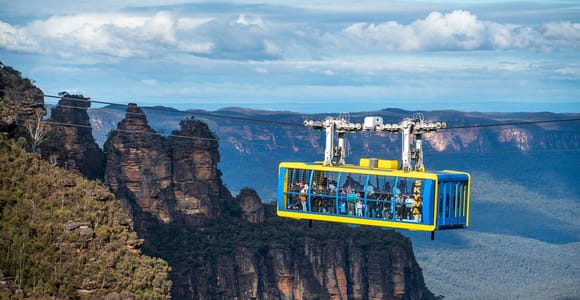
Not for the Blue Mountains. This is the trip most visitors assume needs a car, and it does not. The Blue Mountains Line runs from Central to Katoomba in about two hours and accepts Opal and contactless payment, so it is charged as an ordinary Opal journey rather than as a separate long-distance ticket. Check the exact return fare in the Transport for NSW journey planner before you weigh it against a day’s hire; it will not be close. Driving costs you tolls on the way out, petrol, and a car park at Echo Point that fills early. Our inventory has 52 Blue Mountains trips, from a small-group day tour with a waterfall walk and lunch at €75.20 to the full-day classic at €131.36, and either beats self-driving for a first visit, because the driver gets to look at the view.
Not for the Hunter Valley. A wine region is the textbook case for not driving, and the operators know it – the Hunter Valley listings start at €28.77 with transport included. Hiring a car so that one person in your group can watch everyone else taste wine is a poor use of A$120.
Yes for the coast. South of the Royal National Park and north towards Port Stephens, the public network becomes slow, indirect or absent, and the point of the trip is the road itself. That is the case made in detail in the drive that is actually worth it. If you are going to hire for one thing, hire for this, and hire for the two or three days it takes rather than the whole stay. Compare rates for a short hire and price it against the equivalent guided day trip before you commit.
Who should ignore all of the above
The general answer is not everyone’s answer.
- Travelling with a baby or toddler. Ferries and trains in Sydney are step-free at most major stops and prams are normal, but a car seat you control beats three changes with a pushchair. Note that hire companies charge for child seats and stock is limited in school holidays – book the seat when you book the car, not at the counter.
- Anyone with limited mobility. The network is good, but Sydney is hilly and some of the best-known spots – The Rocks in particular – involve stairs and steep, uneven lanes. A car that drops you at the door changes what is possible.
- Cruise passengers with one day in port. Do not hire. You will spend your margin of safety in traffic, and the terminal at Circular Quay is standing on top of the transport network already.
- Anyone without a driving licence held for at least twelve months, or under 21. The decision has been made for you; the requirements are set out in the counter-costs article.
In one line
Do not hire a car for Sydney. Consider hiring one for two or three days in the middle of your stay, for the coast rather than the mountains, and spend the rest of the time on a network that caps out at A$9.65 on a Saturday.
Opal caps, station access fees, tolls and parking rates are as published by Transport for NSW, the NSW Government and the City of Sydney and read on 18 September 2026; they change. Tour prices are from our Sydney inventory on the same date.